
Kubernetes and CI/CD stabilization
Deployments were inconsistent, rollbacks were common, and release days were high stress. The team needed a delivery system they could trust again.
- Builds differed across environments.
- Manual hotfixes became normal.
- Release windows kept expanding.
- Incidents followed routine changes.
The job was to make deploy day boring again
This was a delivery-stability engagement. The platform team needed clearer release control, not more pipeline complexity.
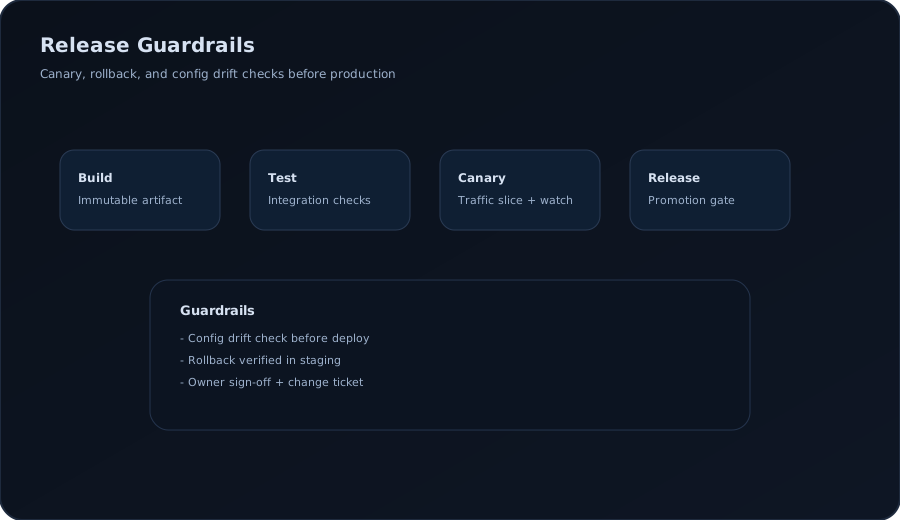
The retained release view showed where artifact integrity, rollout discipline, and rollback confidence were breaking down before incidents reached customers.
The platform did not need a new toolchain. It needed tighter release rules, more deterministic promotion, and fewer places where drift could creep in between build and production.
Standardize the release path before chasing speed
Release reliability improved when the team stopped treating every failure as a one-off hotfix.
First 72 hours
Capture the last known good release baseline, stop unsafe manual patches, and align rollback checks across the highest-risk services.
Next 2 weeks
Normalize pipeline behavior, tighten promotion rules, and remove the config drift that kept breaking parity across environments.
Context
Kubernetes-based SaaS platform, frequent releases, limited engineering bandwidth, and no reliable downtime window.
Success criteria
Rollback success improved, deploy windows tightened, and on-call stopped treating every routine release as an incident-risk event.
What the team kept after stabilization
The retained material was operational, not decorative. It stayed useful after the immediate engagement.
Release guardrails
- Immutable artifact tags verified
- Canary path and rollback tested
- Environment config drift checked
- Owner sign-off recorded before promotion
Why this mattered to the team
- Release readiness stopped depending on memory or heroics.
- Rollback decisions became faster because the checks were pre-defined.
- Ownership stayed clear enough for the internal team to keep operating safely.
Two failures from this class of work, in full detail
Anonymized specifics from real engagements. A buyer summary is not checkable; this is. Where the source records no number, none is claimed.
The situation. A B2B marketplace platform running eleven microservices across separate development, test and production environments. Kubernetes on-premises for dev and test, a managed cloud cluster for production. GitLab CI handled both build and deploy, NGINX was the ingress controller, and cert-manager with Let’s Encrypt was meant to be handling TLS.
What was actually wrong. Three faults compounding, and the third was the visible one. Splitting dev and test into separate namespaces produced NGINX ingress conflicts, because both environments were served under the same root path. That is a path collision, not a namespace problem, so adding namespaces made it worse. Underneath it, cert-manager’s ACME solver was not reachable from the ingress at all, so the HTTP-01 challenge could not complete and certificates would not issue. The team could see that TLS was broken without being able to see why, because the cause was one layer below the certificate configuration everyone was looking at.
What I changed. Moved routing off shared paths onto subdomain-based routing, one subdomain per environment, with a separate Ingress resource per namespace and unique NGINX annotations so the two could not collide. Issued a separate certificate per subdomain rather than one spanning several. For the ACME failure: added explicit .well-known/acme-challenge paths so the solver was reachable, recreated the ClusterIssuer with the correct ingressClass, then deleted and reapplied the cert-manager CRDs to clear the broken state. Separately, moved deployment off GitLab CI onto a GitOps model, with CI building and pushing images and ArgoCD handling continuous deployment.
The result. The routing conflict and the certificate issuance failure were both closed, and certificate auto-renewal moved under cert-manager rather than depending on someone remembering. The source records these as implemented fixes and states no downtime or time-saved figure, so none is claimed.
The situation. A single API endpoint timed out in staging. Only in staging, and only for one status value out of several the endpoint accepted. Every other value returned normally and the same code worked elsewhere. This is the shape of bug that quietly consumes a week.
What was actually wrong. Two faults stacked, and neither was in the application code. Working down the request path, ingress, DNS, service and pod reachability were all healthy, which ruled out the infrastructure explanation people reach for first. Tracing the code path showed the failing status value was the only one dispatching a background job. Staging was configured with a synchronous queue driver, so the job that should have been queued ran inline inside the request and blocked the response until it timed out. The queue-worker Deployment was also missing from the namespace entirely, so even with the correct driver nothing would have consumed the job. It only reproduced in staging because staging had drifted, and nothing was enforcing that the environments match.
What I changed. Switched staging to an asynchronous queue driver and deployed a dedicated queue-worker pod so the job had a consumer. Then the part that matters more than the fix: aligned staging with development through the Helm chart, the GitOps application and CI, so the drift that caused it cannot silently return. Fixing the symptom without closing the drift would have left the same bug free to reappear in another environment.
The result. The endpoint returned to normal response times, and the environment difference that produced the fault was removed from the deployment path rather than corrected by hand. The source records the diagnosis and the fix and states no latency figure, so none is given.